Discover how data governance in ERP systems lays the foundation for business success by ensuring data accuracy, compliance, and efficiency. Learn key strategies and best practices.


Organizations today invest billions in Enterprise Resource Planning (ERP) systems like SAP S/4HANA or Oracle Cloud ERP, aiming to unify finance, operations, and supply chain processes into a single, real-time operational backbone.
Yet, despite this investment, poor data management continues to undermine ERP success. Gartner and Precisely estimate that poor data quality costs organizations an average of $9.7-$15 million annually, often in the form of operational inefficiencies, compliance penalties, and lost revenue.
The stakes for ERP programs are particularly high. According to Gartner, over 70% of ERP initiatives fail to fully meet their original business objectives, a failure frequently rooted not in the software itself, but in data integrity gaps, inconsistent master data, and process misalignment.
This reality underlines a critical truth: data governance is not a soft policy; it is the technical scaffolding that converts multi-billion-dollar ERP investments into measurable business value. Without it, even best-in-class ERP systems cannot deliver a single source of truth.
In this article, we’ll explore the role of data governance in ERP systems, why it matters, and how it can empower organizations to maintain clean, enriched, and reliable data.
We’ll also discuss how effective data governance supports key ERP functionalities like bill of materials (BOM) management, work order processing, and intelligent document processing, all while keeping the language simple and accessible.
A common misconception is that data governance and data management are interchangeable. Understanding the basics of master data governance is essential in ERP environments, as the distinction between governance and management is both clear and operationally critical:
Data Governance: The “What” and the “Who”
Data Governance establishes the prescriptive framework:
This framework ensures accountability and consistency across modules, forming the backbone for operational and financial integrity.
Master Data Management: The “How”
Master Data Management (MDM) is the technical implementation layer that enforces governance policies within the ERP system. Platforms like SAP MDG (Master Data Governance) or native ERP MDM modules operationalize governance by providing:
The “Golden Record” concept is central: a single, authoritative version of each Material, Customer, or Vendor record prevents duplicates and ensures integrated modules such as FI, SD, and MM operate reliably.
Implementing an ERP system represents a major investment for companies. Without adequate data governance, companies run the risk of:
Example: A company maintaining multiple vendor records with slight variations may inadvertently pay the same invoice twice or miss negotiated discounts, affecting costs and supplier relationships.
Data Quality Management
Data quality underpins ERP effectiveness. According to a report by Industry Select, companies can lose up to 15% of their revenue due to inaccurate data, including wasted marketing expenses and resources.
Data Security and Privacy
Regulatory pressures (GDPR, CCPA) demand robust data security:
Automated Workflow and Stewardship
As per Actian, employees spend up to 27% of their time correcting bad data, slowing decision-making, and increasing operational costs. ERP-native workflows enforce mandatory policy compliance:
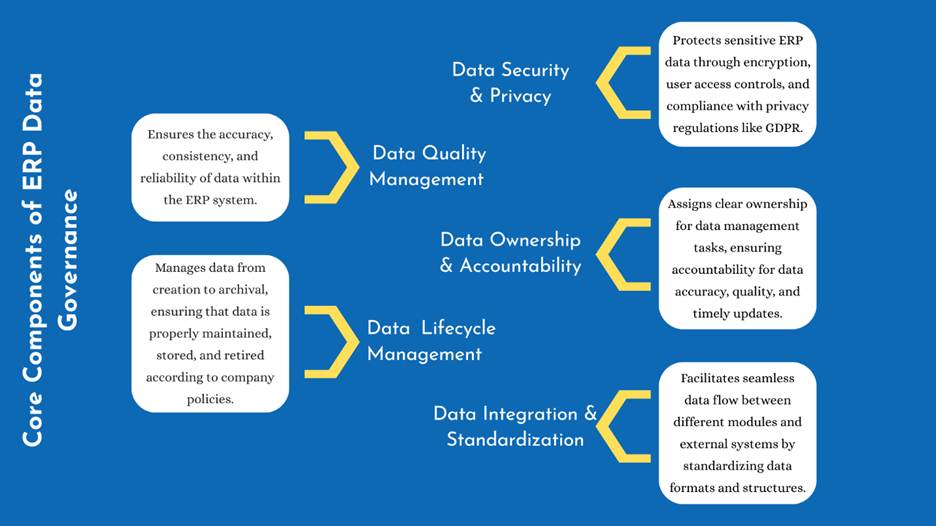
Core components of ERP Data Governance
Implementing an ERP system is a massive undertaking, often involving months of planning, customization, and training. Master data governance plays a crucial role in making this process smooth and successful. Here’s how:
Ensuring Data Quality Before Migration
ERP deployment involves migrating data from multiple legacy sources. Poorly managed data can include duplicates, missing fields, and inconsistent formats. Bad data can cause companies to miss out on 45% of potential leads, including duplicate data and invalid formatting.
Governance processes ensure data is cleansed, standardized, and enriched before migration.
Example: Intelligent document processing can extract structured data from PDFs or scanned documents, ensuring only high-quality data enters the ERP system.
Standardizing Processes Across Departments
ERP systems connect multiple departments. Governance policies ensure consistent data entry and storage, reducing errors and improving efficiency.
Example: BOM product descriptions follow standardized formats, simplifying tracking and work order management.
Reducing Implementation Risks
A poorly managed ERP implementation can lead to budget overruns, delays, or even complete failure. Data governance mitigates these risks by providing a clear framework for data validation, testing, and monitoring during the implementation phase.
According to Dion Rooney, 75% of ERP strategies are not strongly aligned with business objectives, leading to poor outcomes.
By identifying and resolving data issues early, businesses can avoid costly rework and ensure the system meets their needs.
With ERP transformations, even the governance landscape is changing, such as ERP migrations or upgrading other legacy ERP systems, which present unique challenges for implementing data governance. Organizations often face the following issues:
Example: During an SAP ECC → S/4HANA migration, a manufacturing company discovered that material master data contained hundreds of duplicate product records. Without governance policies enforced pre-migration, the duplicates led to misaligned BOMs, disrupted production scheduling, and delayed S/4 go-live.
To realize the full benefits of master data governance, enterprises should consider the following best practices:
To realize the full benefits of master data governance, enterprises should consider adopting a structured master data governance model that defines clear ownership, standardized policies, and automated stewardship processes. This ensures ERP systems maintain high-quality, consistent, and compliant data across all modules.
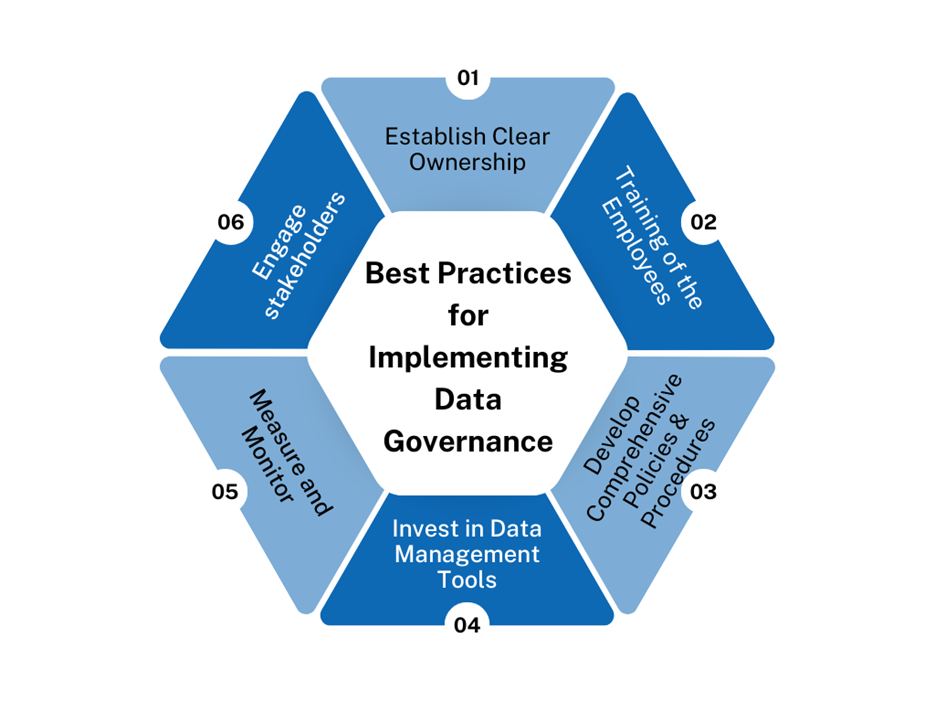
Best practices for implementing Data Governance
The ROI of master data governance in ERP environments extends beyond operational efficiency; it is fundamentally risk mitigation. Properly governed data:
With the increasing adoption of cloud ERP solutions, cloud data governance becomes critical. It ensures that data hosted in cloud environments maintains the same levels of integrity, security, and compliance as on-premises systems.
Ultimately, data governance is the non-functional requirement that defines ERP success. It must be mandated by the C-suite and operationalized at the technical level through workflows, MDM, Golden Record enforcement, and automated quality monitoring.
Organizations that treat governance as an afterthought jeopardize the strategic value of their ERP investment; those that embed it at the architectural level secure a reliable, auditable, and high-performing system capable of delivering measurable business outcomes.
Sandip Roy is a seasoned leader in digital transformation for different industries, bringing over 34 years of expertise in supply chain management and enterprise transformation. He has led large-scale SAP implementations, S/4HANA migrations, and process optimization programs across India, Europe, and Southeast Asia. Renowned for integrating AI-driven innovation into business operations, Sandip advises organizations on enhancing operational agility and driving digital excellence in the energy and natural resources sectors.
Cloud Data Insights is a blog that provides insights into the latest trends and developments in the cloud data space. We cover topics related to cloud data management, data analytics, data engineering, and data science.
Property of TechnologyAdvice. © 2026 TechnologyAdvice. All Rights Reserved
Advertiser Disclosure: Some of the products that appear on this site are from companies from which TechnologyAdvice receives compensation. This compensation may impact how and where products appear on this site including, for example, the order in which they appear. TechnologyAdvice does not include all companies or all types of products available in the marketplace.